About

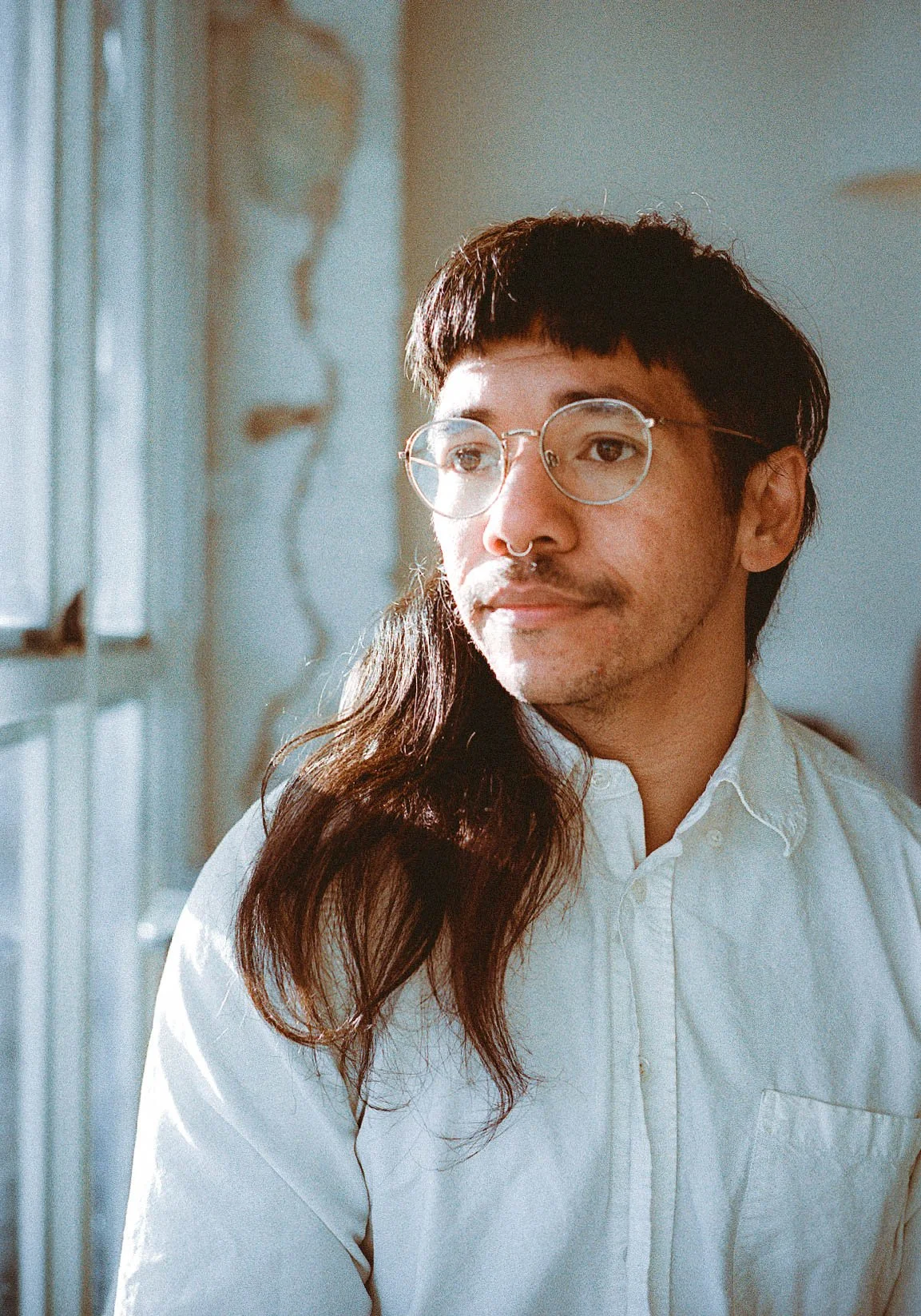
A person with glasses and a septum piercing looking out a window in natural light, with an abstract face illustration on the wall behind them.

Joma Geneciran (they/them) is an organizer, researcher, and documentary photographer living and working on occupied Tongva land, colonized as Los Angeles. As a Filipino-American cultural worker and PhD candidate in Global and International Studies at UC Irvine, their practice spans photography, political economy, and public scholarship—documenting from within the social movements, agrarian struggles, and cultural scenes they engage with.

Geneciran grew up on Ais territory along Florida's east coast, shaped by the contradictions of living between worlds—Filipino and American, rooted and displaced. Their grandfather and generations before him farmed rice in Pampanga until the 1991 Mt. Pinatubo eruption displaced them from the land—the same year Geneciran was born. Their mother left Pampanga for the United States as an overseas worker in 1986, the same year Marcos was overthrown in the People Power Revolution and fled to Hawaii. This family history revealed how land loss and labor export produced their own diasporic position. They became a photographer through documenting protest and organizing around anti-imperialist, climate justice, and anti-colonial struggles, understanding the camera as both witness and tool for collective memory. In the Philippines, mass movements organize annually around the memory of particular ruptures—the end of martial law, the overthrow of Marcos, the State of the Nation Address. Geneciran's artistic practice participates in this tradition, treating collective memory as an agential force rather than passive archive. After 22 years, they returned to the Philippines for extended fieldwork in 2024 and 2025, bringing their research on rice and agrarian transformation home across generations.

Their dissertation, "Following Rice: Agrarian Transformation in the Central Luzon Rice Corridor," examines how the Philippines shifted from rice exporter to the world's largest importer, tracing the political economy of rice through production, circulation, and consumption. This research integrates visual ethnography, archival work, and collaboration with peasant movements in the Philippines. Their visual work has generated several projects: PSONA, a long-form photo series on the People's State of the National Address counter-protest being developed for exhibition and publication; Balik, a diasporic return project exploring absence, homecoming, and belonging; and LA Intifada, exhibited at the Harriet Tubman Center in 2025, documenting resistance against ICE. They also co-host JDPOD, a political education podcast examining global political economy and social movements as public scholarship. Geneciran has published in Middle East Critique and Review of African Political Economy, and teaches courses on global political economy, development, and ideologies at UC Irvine.

Their approach centers Filipino epistemologies—kapwa (shared identity), pakikiisa (solidarity), kwentuhan (storytelling as method)—and visual ethnography as both research method and artistic practice. This integration reflects a consistent commitment to interdisciplinary work: from designing a curriculum across political science, history, critical theory, and photography at New College of Florida, to their current scholarship in Global and International Studies, an emphatically trans/inter/post-disciplinary field. They hold an MA in Anthropology from the University of Chicago (summa cum laude) and a BA in Political Science from New College of Florida.