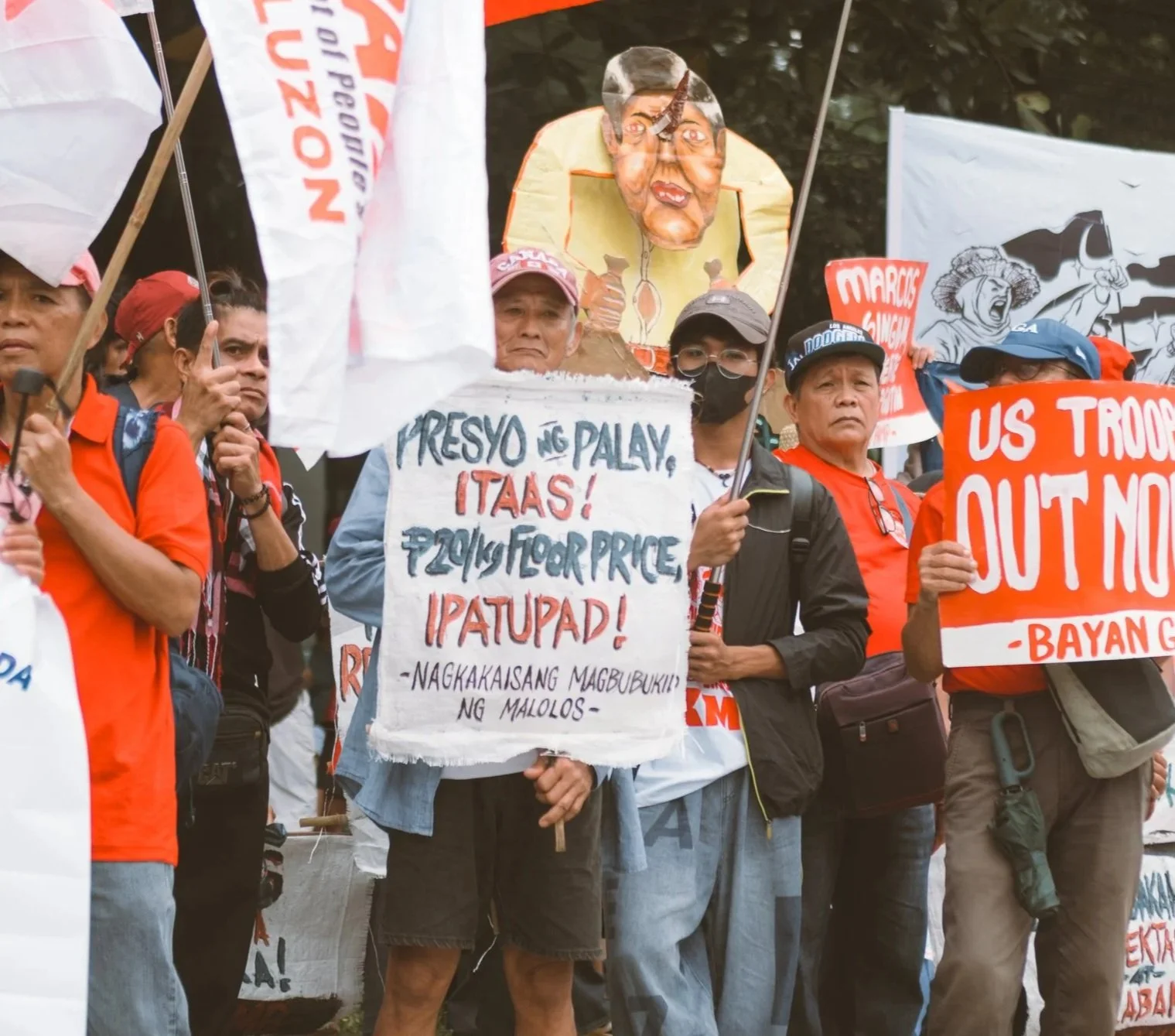
Translation: Raise the price of rice (palay)!
Implement a ₱20/kg floor price!
—United Farmers of Malolos”
Ph.D. Dissertation in Progress
This dissertation investigates the unresolved agrarian question in the Philippines through the political economy and political ecology of rice. For more than half a century, successive Philippine administrations have placed national rice self-sufficiency at the center of development policy, mobilizing agricultural science, irrigation, credit, land reform, price regulation, and trade policy toward that end. Yet despite briefly achieving net-exporter status in the early 1980s, the Philippines became the world’s largest rice importer by 2008. The dissertation asks how successive state projects have organized the governance of rice and agrarian transformation, why rice self-sufficiency and meaningful land reform have remained elusive, and how competing models of development have sought to reorganize agrarian land, labor, and social reproduction.
I argue that rice import dependence is not primarily the result of technological backwardness or failed productivity. It emerged through successive attempts to modernize agriculture without substantial redistribution, secure cheap food without transforming wages and rural livelihoods, export labor without domestic industrialization, and redirect agrarian land toward urban, logistical, speculative, energy, and strategic forms of accumulation. These processes have reorganized rather than resolved the agrarian question, dispersing its contradictions across precarious work, overseas migration, remittance dependent households, ecological vulnerability, and former agricultural lands claimed for development.
The dissertation also challenges the popular accounts of the Philippine state as either a coherent developmental actor or an institution simply weakened or captured by oligarchic interests. Drawing on Philip Abrams, Nicos Poulantzas, and Samir Amin, I approach the peripheral capitalist state as internally differentiated and embedded within unequal relations of class power and the world economy. I disaggregate the state into institutions and apparatuses that constitute rice differently, including as a problem of plant productivity, water control, tenancy, credit, price stability, trade, and territorial development. I then examine how particular projects acquire coherence within the state and become dominant policy common sense.
This approach also foregrounds what I call surname sovereignty, the durable capacity of political families to convert control over land, property, and state institutions into successive forms of accumulation. Family centered vignettes trace how dynastic power intersects with key moments of agrarian reform, trade liberalization, infrastructure development, and land conversion.
“Following rice” is both a method and an analytical strategy. The project traces where rice is produced, who controls land and irrigation, who finances cultivation, who purchases and mills palay, how imports and warehouses shape prices, and what happens to agrarian territory when rice production is displaced or rendered unviable.
Fieldwork centers on what I call the Central Luzon Rice Corridor, an analytical geography linking Nueva Ecija, Bulacan, Metro Manila, Pampanga, and Tarlac through relations of production, circulation, consumption, infrastructure, and land conversion. The concept draws on and critically reworks the language of corridors, growth regions, and strategic development zones through which Philippine planners have long imagined and reorganized territory. Across these sites, the dissertation examines the historical transformation of rice governance, the contemporary rice economy following the 2019 Rice Tariffication Law, and infrastructure projects such as New Clark City and emerging strategic corridors that reorganize agrarian space and project new futures of accumulation.
Methods include archival and sociohistorical research, legal and policy analysis, interviews, statistical analysis, spatial investigation, and visual political economy. The project draws on fieldwork conducted in the Philippines during the summers of 2024, 2025, and 2026.